

CERES Certified Training Path
Research-based, market-driven learning to power the circular transition
The CERES Certified Training Path equips students, VET learners, and professionals with up-to-date skills for the circular economy—combining a rigorous curricula, hands-on hackathons, and a vibrant digital community.
Why CERES
- Research-based: Built from an in-depth needs analysis of the competencies required by today’s labour market for the circular transition.
- Practice-oriented: Learn, apply, and validate skills through real cases, projects, and assessment.
- Community-powered: Keep learning through the CERES Hub—our digital ecosystem for exchange, mentoring, and good practices.
What’s Included:
1) CERES Curricula (Certified Learning Path)
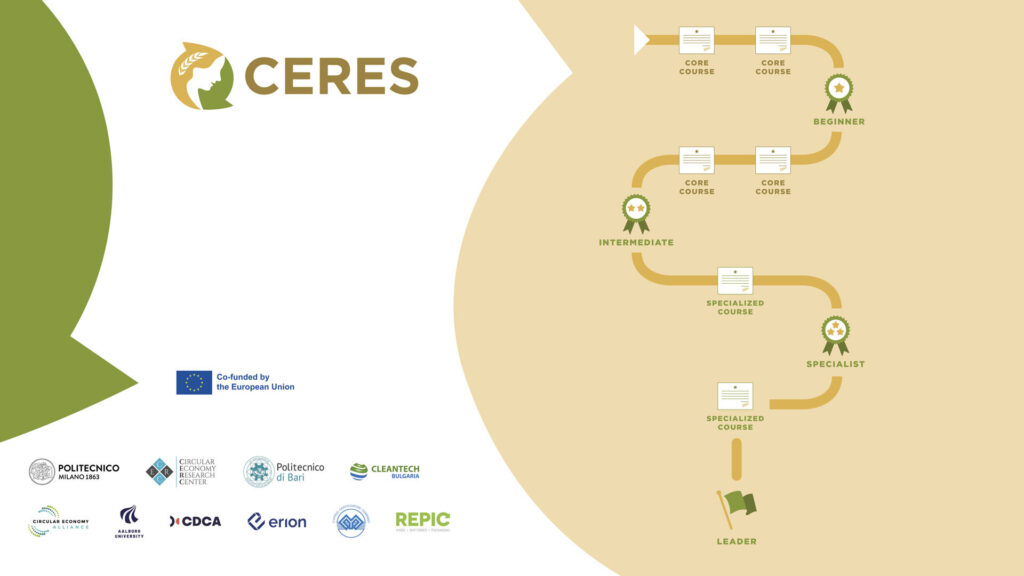
A structured pathway composed of 4 Core Courses (MOOCs) and 2 Specialised Modules (hybrid).
A complete and certified learning pathway that includes:
- 4 Core Courses (MOOCs) – available online and asynchronous, providing a foundational understanding of circular economy principles.
- 2 Specialised Modules – hybrid delivery (in-person and online), focusing on:
- Circular Lifecycle Management
- End-of-Life Product Management
Each course and module includes:
Recordings and resources accessible through the CERES Hub where you will find:
- Pre-course readings, case studies, and extra learning material
- Recordings and resources accessible through the CERES Hub
Assessment & Certification: Exams are taken on the CERES LMS. Successfully completing the pathway leads to the CERES Certificate and a Digital Badge. (Institutional ECTS recognition may apply; see Trainee Guide.)
Who It’s For
The CERES Certified Training Path is designed for:
- Higher Education students who want to gain specialised expertise in circular economy topics.
- VET learners and recent graduates aiming to expand their qualifications beyond EQF level 5.
- Professionals and industry staff working in sustainability, innovation, and production who want to upskill or reskill.
- Educators and trainers interested in updating their curricula with state-of-the-art circular economy knowledge.
- Public authorities and policymakers supporting education and sustainable transition initiatives.
- Companies and SMEs seeking collaboration, innovation, and access to circular business solutions.